
Proper Operation
Learn how your appliance is supposed to operate so you can determine if it is malfunctioning.
- Dryer Controls
- Moving Air
- Automatic Cycles
- Moisture Sensor
- Even Heat Control
- Rotating Drum
- Generating Heat
- Dryer Sounds
This page contains affiliate links. For more information visit our
FTC disclosure page.
- Visit our sponsor for parts:

Automatic Cycles

When electric dryers appeared on the market more than forty years ago, the housewife guessed how many minutes it would take to dry the clothes. This was an inexact science, at best, and twenty years or more later, schemes were invented to sense when the clothes were dry and to shut the dryer off. Some of the designs to sense moisture in clothes were very complex. Various sensors were imbedded in the back or front wall of the dryer interior. Most systems were based on measuring the resistance of the clothing the sensors came into contact with as their moisture content decreased as they dried. As often happens, the complexity of the moisture measurement systems led to reduced reliability and sometimes even ruined clothes!
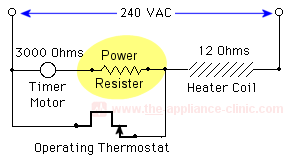
Many Whirlpool built automatic dryers employ a very simple, reliable design for sensing when the clothes are likely to be dry. It is based on the fact that dry clothes will not absorb as much heat as wet clothes will. Therefore, the dryer exhaust temperature rises quicker as the clothes are nearly dry. A 4000 to 5000 ohm "power resistor" is switched in series with the timer motor for the automatic cycles. The timer motor and resistor are connected in parallel with the operating thermostat. The timer motor, resistor and thermostat are then connected in series with the heater coil.
The timer motor advances only when the operating thermostat is open, turning off the heat. A small current flows through the heater coil, the resistor and the timer motor when the thermostat is open. The amount of time that the operating thermostat is open increases as the clothes get drier. The timer motor merely moves the timer dial toward the "off" position when powered. If a large load of clothes that will take longer to dry are loaded into the dryer, the timer is set such that it will take the motor longer to move the pointer to "off".
There is no "sensor", just the operating thermostat which never actually touches the clothes. An automatic dryer cycle is achieved with the addition of that resister and a slightly more complex timer than models without an 'auto' setting.
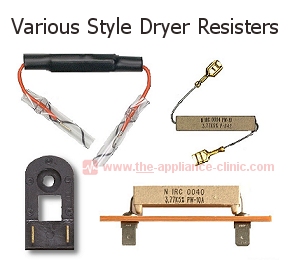
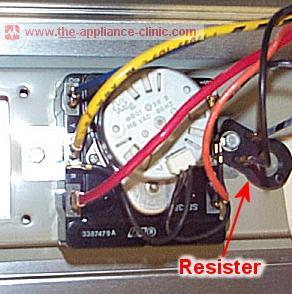
The power resister is usually found inside the control panel often in close proximity to the timer. It could be of various physical shapes; a small disc (see illustration), rectangular with or without attached metal mounting bracket or just an inline design with wire leads.
All types Whirlpool has used previously are replaced with the same kit, part number 279872, which is an inline style with insulated terminals that replaces all previous configurations and comes with installation instructions.
Click the banner to visit our sponsor to purchase parts:
